Dressed for Doubt: How Your Visa Interview Outfit Can Undermine an Otherwise Strong Application
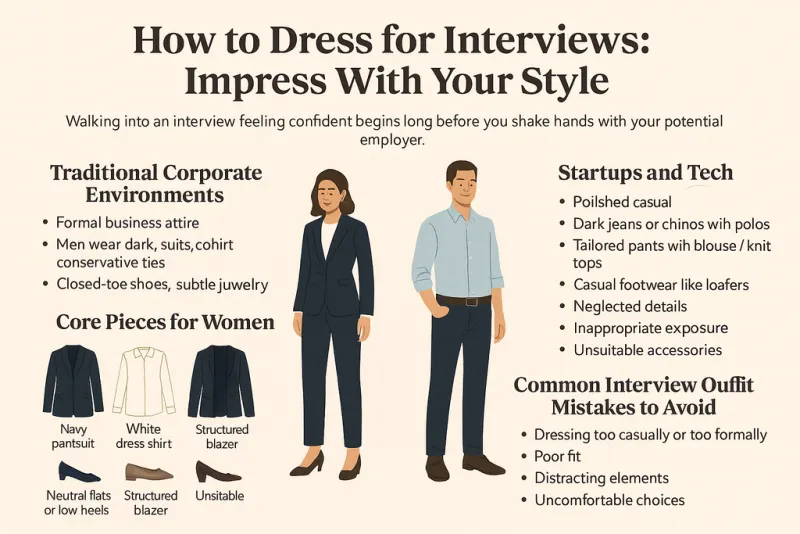
Photo: professional person choosing outfit before job interview mirror formal attire, via cdn.shopify.com
Visa applicants invest considerable energy in assembling financial records, drafting personal statements, and rehearsing responses to anticipated questions. What receives far less attention is the silent communication that begins the moment an applicant steps into the consular waiting area. Before a single document is reviewed or a question is asked, a consular officer has already registered something about you — and your appearance plays a larger role in that initial impression than most applicants realize.
This is not an argument for carelessness. Appearing disheveled, underdressed, or visibly unprepared carries its own risks. The issue is more specific: in certain circumstances, an overly polished, conspicuously expensive, or evidently rehearsed presentation can raise subtle questions in an officer's mind rather than resolving them.
Understanding why this happens — and how to calibrate accordingly — is a meaningful part of a well-rounded interview strategy.
What Consular Officers Are Actually Evaluating
Consular officers are trained to assess whether an applicant's stated circumstances align with observable reality. For nonimmigrant visa categories in particular, officers are looking for coherence: does this person's life, as presented in their documents, match the person standing in front of them?
Appearance becomes a data point in that assessment. An applicant who presents as a mid-level schoolteacher from a modest economic background but arrives in what appears to be a designer suit and luxury accessories may inadvertently create a discrepancy. The officer is not necessarily concluding that something fraudulent is occurring — but they may find themselves searching for an explanation, and that search tends to generate additional scrutiny.
Conversely, an applicant whose documents indicate substantial business ownership but who arrives in casual, careless attire may prompt questions about the legitimacy of the financial profile being presented.
The underlying principle is consistency. Your appearance should feel like a natural extension of who you are and what your application says about your life.
The Rehearsed-Applicant Problem
One pattern that experienced immigration consultants observe is what might be called the "coached appearance" effect. Applicants who have read extensively about visa interviews — or who have received guidance that emphasizes projecting success — sometimes arrive looking as though they have dressed for a role rather than for a conversation.
This can manifest in small but telling ways: an outfit that fits impeccably but feels slightly incongruent with the applicant's stated profession; accessories that seem inconsistent with a declared income level; or a level of formal presentation that feels performative rather than natural in the context of the specific visa category being pursued.
Officers who conduct hundreds of interviews each month develop a sensitivity to presentation that feels authentic versus presentation that feels constructed. Neither extreme — conspicuous wealth nor obvious underdress — serves the applicant well. What officers respond to most favorably is a presentation that feels honest.
Cultural Context Matters — But Has Limits
It is worth acknowledging that norms around professional dress vary significantly across cultures, and what reads as "overdressed" in one context may be entirely standard in another. Applicants from regions where formal attire signals respect for institutions may arrive in clothing that reflects genuine cultural norms, not strategic calculation.
Consular officers are generally aware of these differences and are trained to contextualize appearance accordingly. However, this cultural latitude has practical limits. If an applicant's supporting documents indicate financial circumstances that are inconsistent with the visible cost of their attire — regardless of cultural context — that inconsistency may still register as worth examining.
The practical guidance here is to dress in a way that is culturally appropriate for you, professionally appropriate for the visa category, and financially consistent with what your documents describe.
Specific Scenarios Where Appearance Has Complicated Cases
At Star Visa Consultants, we work with clients across a wide range of visa categories, and we have observed several recurring patterns where appearance choices inadvertently introduced complications.
Tourist and visitor visa applicants who arrive in business-formal attire sometimes create confusion about the nature of their visit. Officers may wonder whether the stated purpose — leisure travel or family visits — aligns with the professional presentation. A neat but relaxed appearance tends to serve these applicants better.
Student visa applicants who dress in a manner suggesting significant personal wealth can sometimes trigger questions about financial sponsorship and ties to their home country. If an applicant's financial support is coming from a family member and the documents reflect modest means, an appearance of affluence may prompt the officer to probe more carefully.
Employment-based visa applicants face a different calibration challenge. In these cases, projecting professional competence is appropriate and expected — but the specific industry matters. A software engineer interviewing for an H-1B might reasonably appear in business casual attire. Arriving in a formal three-piece suit may actually read as slightly incongruous in a tech context, where industry norms skew less formal.
Applicants with prior visa complications — including previous rejections or overstays — sometimes overcorrect in their presentation, arriving in clothing that feels like an attempt to project a new identity rather than a natural reflection of who they are. Officers who review the application history before the interview may notice this disconnect.
Practical Guidance for Getting the Balance Right
The goal is not to dress down, nor to dress up, but to dress accurately — in a way that is consistent with your professional background, your financial profile, and the nature of the visa you are seeking.
Research the norms for your visa category. The appropriate presentation for a business visa interview differs from that of a student visa or a family-based petition. Understanding these distinctions helps you calibrate without overthinking.
Consider your documented financial profile. Your appearance should be plausible given what your financial documents reflect. This does not mean dressing poorly if you have modest means — it means avoiding a presentation that creates an unexplained gap.
Dress for your actual profession. If your application identifies you as an educator, a healthcare worker, or an artist, your clothing should feel consistent with that professional identity. Dramatic departures from that identity — in either direction — can introduce questions.
Avoid visible branding that signals price. Prominent luxury logos, high-end accessories, or clearly expensive items can inadvertently shift focus. Clean, well-maintained clothing without conspicuous status markers tends to keep the conversation where it belongs: on your documents and your answers.
When in doubt, ask a professional. This is an area where working with an experienced immigration consultant adds genuine value. A good consultant can review your overall presentation — including your documents, your rehearsed responses, and yes, your intended attire — and identify any inconsistencies before the interview.
The Larger Principle
Visa interviews are, at their core, exercises in credibility. Officers are not looking for the most impressive applicant — they are looking for the most coherent one. Every element of your presentation, from the organization of your documents to the way you answer questions to the clothes you wear, contributes to a single underlying impression: does this person's story hold together?
Dressing appropriately is not about performing success or projecting humility. It is about presenting yourself in a way that feels honest, consistent, and aligned with the life your application describes. When those elements are in sync, your appearance becomes one less thing an officer needs to explain — and that, quietly, works in your favor.
Star Visa Consultants provides comprehensive interview preparation services for clients across all major U.S. visa categories. Contact our team to schedule a consultation.